
State-owned Enterprises(SoEs) in Pretoria
32 results
Get quotes from multiple providers
Describe your job once and compare quotes from State-owned Enterprises(SoEs) providers — no payment now.

The beginning of the Government Employees Medical Scheme (GEMS) was a historic moment when, in 2002, the Cabinet approved a framework policy on a restricted (closed) medical scheme for further development by an interdepartmental working group (Departments of Public Service and Administration, National Treasury, Health, Education, Correctional Services and SAPS). The approved framework policy centred on the principles of equity, efficiency and differentiation: equity, where employees have equal access to the most extensive set of equal basic benefits under equitable remuneration structures, subject to affordability; efficiency, regarding the costs and delivery of benefits; differentiation, where employees choosing more extensive cover have equal access to higher benefits subject to their needs; and government's commitment to an equitable and affordable medical scheme. The Cabinet gave the development and implementation of GEMS intense consideration, relying on substantial research and data analyses. The implementation of GEMS is a positive step that positions government as an employer of choice that truly cares for the health and wellbeing of its employees. GEMS was registered on 1 January 2005 specifically to meet the healthcare needs of government employees. It offers six excellent healthcare benefit options, namely Tanzanite One, Beryl, Ruby, Emerald Value, Emerald and Onyx. Its goal is to help public service employees and their families to get the best possible healthcare at the most affordable rate.

Serving South Africa for more than 50 years, the Human Sciences Research Council (HSRC) is the largest research institute in Africa focusing on the social sciences and humanities. It produces and disseminates knowledge that contributes to policies and programmes to alleviate poverty, reduce inequality, and stimulate innovations for employment creation. More than knowledge production, the HSRC works towards the uptake of research for policy and impact. Collaborations and partnerships are critical and include local, regional and international public, private and community entities.

The mission of the Independent Development Trust (IDT) is to manage and deliver integrated social infrastructure programmes on behalf of government on time, cost-effectively and through a people-centred approach. The IDT is a schedule 2 state-owned entity that manages the implementation and delivery of critically needed social infrastructure and social development programmes on behalf of the South African government. The IDT reports to the Minister of Public Works and Infrastructure, who is the executive authority and the shareholder representative. The IDT's national office is located in Pretoria, and has provincial offices in the country's nine provinces. The IDT was established in 1990 and was allocated a grant of R2 billion by government to support education, housing, health services and business development projects in previously disadvantaged and mainly rural areas. After 1999, the IDT was reconfigured and listed as a schedule 2 programme implementation agency as prescribed by the Public Finance Management Act (PFMA) 1 of 1999. From 1999 to date, the organisation has delivered approximately R27,4 billion worth of social infrastructure and social development programmes across the country.

The aim of the International Trade Administration Commission of South Africa (ITAC) is to foster economic growth and development in order to raise incomes and promote investment and employment in South Africa and within the Common Customs Union Area by establishing an efficient and effective system for the administration of international trade, subject to the International Trade Administration Act and the Southern African Customs Union (SACU) Agreement. The Commission's core functions are: customs tariff investigations; trade remedies; and import and export control.
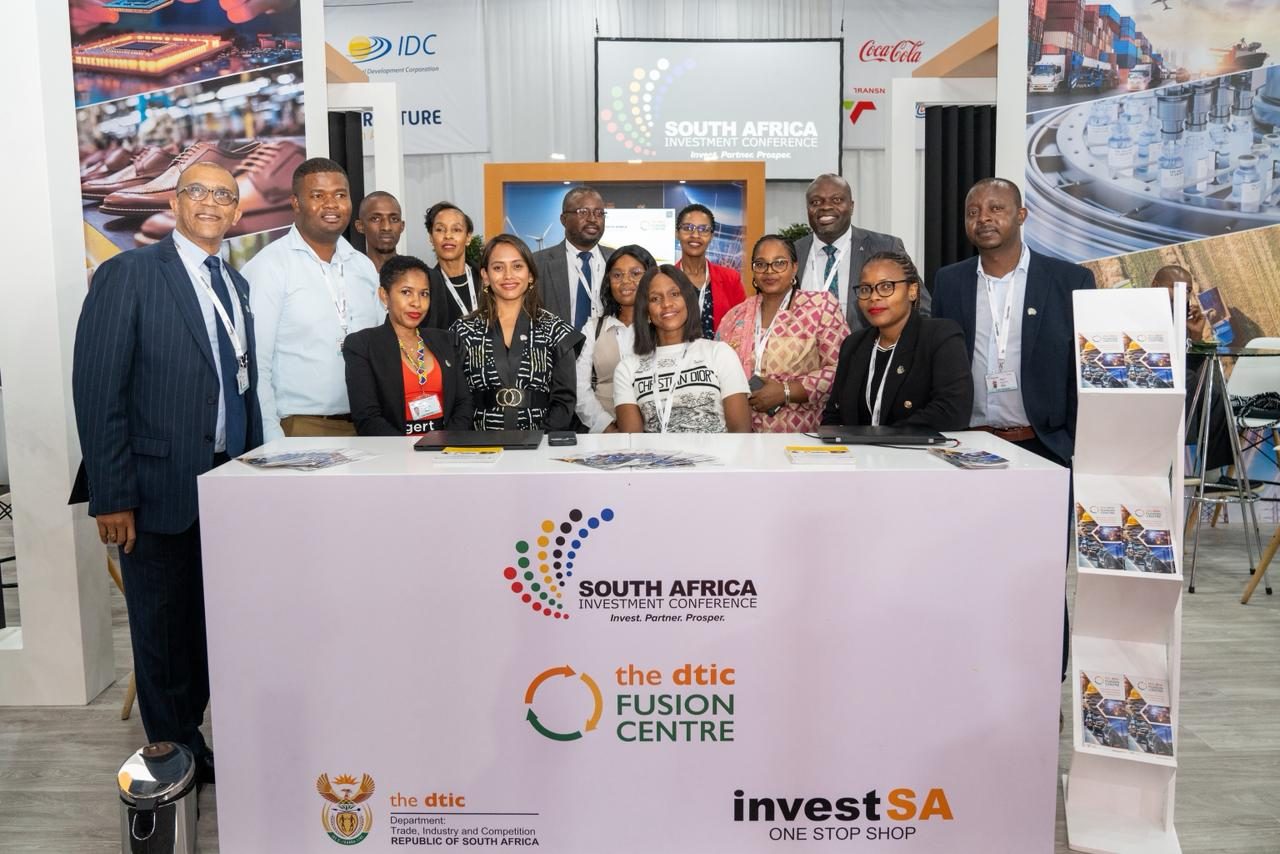
South African Department of Trade, Industry and Competition (the dtic), providing a One-Stop-Shop service to investors. It provides investment promotion, facilitation and aftercare, which is geared at fast-tracking projects and reducing government red-tape.

The mission of the National Agricultural Marketing Council (NAMC) is to provide agricultural marketing advisory services to key stakeholders in support of a vibrant agricultural marketing system in South Africa. The Council's strategic objectives are to: increase market access for all market participants; promote the efficiency of the marketing of agricultural products; optimise export earnings from agricultural products; and enhance the viability of the agricultural sector. The Council serves through the following initiatives: research on trade, linking farmers to markets, monitoring food prices and inputs costs, as well as value chain; development schemes aimed at leveraging the potential of smallholder agriculture through partnerships, as well as technical assistance and training programmes; industry trusts; bridging the communication gap between industry and the ministry; statutory measures; and investigating statutory measure applications.

The mission of the National Consumer Commission (NCC) is to promote compliance with the Consumer Protection Act through advocacy and enforcement, in order to ensure fair business practice and uphold the social and economic welfare of consumers. The NCC is charged with the responsibility of enforcing and carrying out the functions assigned to it in terms of the Consumer Protection Act. The Act seeks to promote a fair, accessible and sustainable marketplace for consumer products and services and, for that purpose, to establish national norms and standards relating to consumer protection throughout South Africa. It further seeks to: provide for improved standards of consumer information; prohibit certain unfair marketing and business practices; promote responsible consumer behaviour; and promote a consistent legislative and enforcement framework relating to consumer transactions and agreements.

The National Energy Regulator of South Africa (NERSA) is a regulatory authority established as a juristic person in terms of section 3 of the National Energy Regulator Act 40 of 2004. NERSA’s mandate is to regulate the electricity, piped-gas and petroleum pipelines industries in terms of the Electricity Regulation Act 4 of 2006, Gas Act 48 of 2001 and Petroleum Pipelines Act 60 of 2003. NERSA's vision is to be a recognised world-class leader in energy regulation and its mission is to regulate the energy industry in accordance with government laws and policies, standards and international best practices in support of sustainable development. NERSA’s mandate, as contained in the relevant legislation, is summarised as follows: Issuing of licences and setting pertinent conditions; setting and/or approving tariffs and prices; monitoring and enforcing compliance with licence conditions; dispute resolution including mediation, arbitration and the handling of complaints; gathering, storing and disseminating industry information; setting of rules, guidelines and codes for the regulation of the three industries; determination of conditions of supply and applicable standards; registration of import and production activities. The role of NERSA is to ensure the development and sustainability of the electricity, piped-gas and petroleum pipelines industries, while facilitating the affordability of and accessibility to these industries, to balance the economic interests of all stakeholders, to ensure sustainable socio-economic development of South Africa and a better life for all.

The Innovation Hub (TIH) is the innovation agency of the Gauteng province responsible for conceptualisation and implementation of innovation programmes as well as full development and operation of The Innovation Hub Science and Technology Park (TIH STP) located in Tshwane. It is a wholly owned subsidiary of the Gauteng Growth and Development Agency (GGDA). It was established by the Gauteng Provincial Government through its Department of Economic Development (GDED) to promote economic development and competitiveness of Gauteng through fostering innovation and entrepreneurship. TIH offers a number of incubation programmes in the bioeconomy (agro-processing and pharmaceutical), smart industries (ICT and advanced manufacturing) and green economy (water purification, waste management and renewable energy). In addition, TIH operates a range of enterprise development, skills development and innovation enabling programmes, both in the Science Park and throughout the Gauteng region.

The vision of the National Heritage Council South Africa (NHC) is to be champions of African heritage towards social cohesion. Its mission is to actively advance, promote and celebrate the country's African heritage.
The vision of the Armaments Corporation of South Africa SOC Ltd (ARMSCOR) is to be the strategic partner of choice for defence and security solutions. Armscor is renowned for its acquisition expertise in providing defence turnkey solutions, which encompass technology development, product development and support, product upgrading, as well as disposal of equipment. Its research and development focuses on producing cutting-edge technology products. The organisation prides itself on maintaining high-quality international standards through rigorous testing and evaluation processes on all its technology management projects. Armscor is committed to driving creativity and innovation in collaboration with strategic partners. The organisation also provides marketing support to the South African Defence Industry (SADI).
The vision of the Driving Licence Card Account (DLCA) is to be the trusted leader in the provision of authentic, secure and quality driving licence cards. The Entity's mission is to: prioritise service delivery towards the satisfaction of all its clients; continuously evolve its delivery in line with technology and innovation; foster collaborative relationships with all relevant regulatory stakeholders; and inspire and empower human capital to nurture excellence.
The Government Technical Advisory Centre (GTAC) is a government component in terms of the Public Service Act, with a central mandate to assist organs of state in building their capacity for efficient, effective and transparent financial management. GTAC's long-term strategic intent is to be a centre of excellence in analytical, advisory, institutional development and programme management support to public sector institutions, to better manage and implement their mandates and consequently improve their quality of spend. This will be done through partnerships with academic and research centres focused on public sector management and training. Within the context of government's National Development Plan and medium-term strategic framework, GTAC seeks to contribute to building a capable and development-orientated state, while also strengthening capacity to work with the private sector in promoting growth, employment, infrastructure investment and public service delivery. The main functions and activities include: transaction advisory services; capital projects appraisal; institutional development support; and public expenditure and policy analysis.
The Health Professions Council of South Africa (HPCSA), together with the 12 professional boards under its ambit, is established to provide for control over the education, training and registration for practicing of health professions registered under the Health Professions Act 56 of 1974, as amended. In order to protect the public and guide the professions, the Council ensures practitioners uphold and maintain professional and ethical standards within the health professions.
The vision of the National Advisory Council on Innovation (NACI) is to be a leading advisory body for the government on Science, Technology and Innovation (STI) within a well-coordinated, responsive and functioning National System of Innovation (NSI). Its mission is to provide evidence-based advice to the Minister of Science, Technology and Innovation and, through the Minister, Inter-Ministerial Committee (IMC) and Presidential Plenary for Science, Technology and Innovation (STI), and the Cabinet, on STI matters, through research expertise and stakeholder engagement.
No map locations
These listings don't have coordinates yet.