
Pretoria
10566 businesses

The Competition Tribunal adjudicates competition matters, in accordance with the Act, and has jurisdiction throughout South Africa. It is independent and subject to the Constitution and the law. It must be impartial and perform its functions without fear, favour or prejudice. When a matter is referred to it in terms of the Act, the tribunal must: adjudicate complaints of prohibited conduct (restrictive practice and abuse of dominance); impose a remedy; award costs; grant an order for interim relief; authorise or prohibit a large merger; and adjudicate appeals from the Commission's decisions on intermediate mergers and exemptions.

The mission of the Construction Industry Development Board (CIDB) is to drive enhanced delivery management, capacity improvement and contractor development in the construction industry through strategic interventions and partnerships. The Board's mandate is to: establish a national register of contractors and construction projects to systematically regulate, monitor and promote the performance of the industry for sustainable growth, delivery and empowerment; promote improved delivery management capacity and the uniform application of procurement policy throughout all spheres of government; promote improved performance and best practice of public and private sector clients, contractors and other participants in the construction delivery process; promote sustainable participation of the emerging sector; provide strategic direction and develop effective partnerships for growth, reform and improvement of the construction sector.

The objectives underlying the establishment of the Council for Geoscience (CGS) are to develop and publish world-class geoscience knowledge products and to render geoscience-related services to the South African public and industry. The mandate of the CGS includes: the systematic reconnaissance and documentation of the geology of the earth's surface and continental crust, including all offshore areas within the territorial boundaries of South Africa; the compilation of all geoscience data and information, particularly the geological, geophysical, geochemical and engineering-geological data in the form of maps and documents, which are placed in the public domain; basic geoscience research into the nature and origin of rocks, ores, minerals, formations, the history and evolution of life, and the formation of the Earth, with a view to understanding the geological processes of both the past and present, and to compile and publish such research findings nationally and internationally to contribute to the understanding of the Earth, its evolution and its resources; and the collection and curation of all geoscience data and knowledge about South Africa in the National Geoscience Repository. This repository houses a large and growing collection of geoscience information on all the countries of the African continent. This information also includes data that was received from mining companies, universities and research institutions worldwide. Public access to all geoscience information is subject to: existing legislation, arranged through the mandate of the CGS; rendering of geoscience knowledge services and advice to the state to enable informed and scientifically-based decisions about the use of the Earth's surface and the Earth's resources, within the territory of South Africa; and management of a number of national geoscience facilities on behalf of the country. These include the National Seismograph Network, National Borehole-Core Repository, National Geoscience Heritage Collections (Geoscience Museum), and National Geoscience Library. As part of its seismological monitoring function, the CGS contributes to the verification of global compliance to the ban on underground, underwater and upper atmospheric nuclear explosions in terms of the Comprehensive Nuclear-Test-Ban Treaty (CTBT), by making data available from stations located on South African territory; and rendering commercial geoscience services and products to national and international clients. The Council for Geoscience is one of the national science council in the country. It is the custodian of all geoscientific information in South Africa.

The Council for Scientific and Industrial Research (CSIR) is a leading scientific and technology research organisation that researches and develops transformative technologies to accelerate socioeconomic prosperity in South Africa. The organisation's work contributes to industrial development and supports a capable state. The CSIR is an entity of the Department of Science and Innovation. The organisation plays a key role in supporting the public and private sectors through directed research that is aligned with the country's priorities, the organisation's mandate and its science, engineering and technology competences. The nine high-impact sectors identified by the CSIR to achieve its aims are the following industry advancement clusters: Advanced Agriculture and Food; Next Generation Health; Future Production: Chemicals; Future Production: Mining; Future Production: Manufacturing; Defence and Security Industry and society enabling clusters; Smart Places; Smart Mobility; and Next Generation Enterprises and Institutions. Our core values are the driving force behind our ability to conduct cutting-edge research and technological innovation to improve the quality of life of South Africans. These values make for an EPIC team - one that pursues Excellence, celebrates People, personifies Integrity, and welcomes Collaboration.
The mission of the Council for the Built Environment (CBE) is to lead, regulate, advise and coordinate professions and their councils to meet the National Built Environment and Transformation Future of the industry. The CBE's mandate is to: promote and protect the interest of the public in the built environment; promote and maintain a sustainable built environment and natural environment; promote ongoing human resources development in the built environment; facilitate participation by the built environment professions in integrated development in the context of national goals; promote appropriate standards of health, safety and environmental protection within the built environment; promote sound governance of the built environment professions; promote liaison in the field of training in South Africa and elsewhere and to promote the standards of such training in the country; serve as a forum where the built environment professions may discuss the relevant issues (required qualifications; standards of education; training and competence; promotion of professional status; and legislation impacting on the built environment); and ensure uniform application of norms and guidelines set by the councils for the professions throughout the built environment.

The mission of the Cross-Border Road Transport Agency is to drive an integrated African continent through excellence in cross-border road transport economic regulation, law enforcement, advisory and facilitation of unimpeded flow of goods and people. The Agency was established to provide advice, regulation, facilitation and law enforcement in respect of cross-border road transport, so as to: improve the unimpeded flow of freight and passengers in the region; introduce regulated competition in respect of cross-border road transport; reduce operational constraints for the cross-border transport industry as a whole; enhance and strengthen the capacity of the public sector in support of its strategic planning, enabling and monitoring functions; and empower the cross-border road transport industry to maximise business opportunities and to regulate themselves incrementally to improve safety, security, reliability, quality and efficiency of services.

The Financial Sector Conduct Authority (FSCA) was established by the Financial Sector Regulation Act 9 of 2017 (the FSR Act) to become a dedicated market conduct authority replacing the Financial Services Board (FSB), on 1 April 2018. The FSCA's mandate is to: enhance the efficiency and integrity of financial markets; promote fair customer treatment by financial institutions; provide financial education and promote financial literacy; and assist in maintaining financial stability. The FSR Act extends the jurisdiction of the FSCA to include oversight of financial products and services not overseen by the FSB banking; services related to credit; and the buying and selling of foreign exchange. It also dictates a shift in approach from the FSB's traditional compliance driven model to one that is proactive, pre-emptive, risk-based and outcomes focused. Crucially, the FSR Act includes financial inclusion and transformation of the financial sector in its overall objectives. The FSCA's six priority strategic focus areas for the next three years are: building a new organisation; an inclusive and transformed financial sector; a robust regulatory framework that promotes fair customer treatment; informed financial customers; strengthening the efficiency and integrity of our financial markets; and understanding new ways of doing business and disruptive technologies.

The beginning of the Government Employees Medical Scheme (GEMS) was a historic moment when, in 2002, the Cabinet approved a framework policy on a restricted (closed) medical scheme for further development by an interdepartmental working group (Departments of Public Service and Administration, National Treasury, Health, Education, Correctional Services and SAPS). The approved framework policy centred on the principles of equity, efficiency and differentiation: equity, where employees have equal access to the most extensive set of equal basic benefits under equitable remuneration structures, subject to affordability; efficiency, regarding the costs and delivery of benefits; differentiation, where employees choosing more extensive cover have equal access to higher benefits subject to their needs; and government's commitment to an equitable and affordable medical scheme. The Cabinet gave the development and implementation of GEMS intense consideration, relying on substantial research and data analyses. The implementation of GEMS is a positive step that positions government as an employer of choice that truly cares for the health and wellbeing of its employees. GEMS was registered on 1 January 2005 specifically to meet the healthcare needs of government employees. It offers six excellent healthcare benefit options, namely Tanzanite One, Beryl, Ruby, Emerald Value, Emerald and Onyx. Its goal is to help public service employees and their families to get the best possible healthcare at the most affordable rate.

The mission of the National Prosecuting Authority of South Africa (NPA), guided by the Constitution, is to ensure justice for the victims of crime by prosecuting without fear, favour and prejudice and, by working with their partners and the public, to solve and prevent crime. The National Prosecuting Authority has the power to: institute and conduct criminal proceedings on behalf of the state; carry out any necessary functions incidental to instituting and conducting such criminal proceedings; and discontinue criminal proceedings.

The mission of the South African Law Reform Commission (SALRC) is the continuous reform of the law of South Africa in accordance with the principles and values of the Constitution to meet the needs of a changing society operating under the rule of law. The objectives of the Commission are to do research with reference to all branches of the law of the country and to study and investigate all such branches in order to make recommendations for the development, improvement, modernisation or reform thereof, including the: repeal of obsolete or unnecessary provisions; removal of anomalies; bringing about of uniformity in the law in force in the various parts of the country; consolidation or codification of any branch of the law; and steps aimed at making the common law more readily available. In short, the Commission is an advisory body whose aim is the renewal and improvement of the law of South Africa on a continuous basis.

Serving South Africa for more than 50 years, the Human Sciences Research Council (HSRC) is the largest research institute in Africa focusing on the social sciences and humanities. It produces and disseminates knowledge that contributes to policies and programmes to alleviate poverty, reduce inequality, and stimulate innovations for employment creation. More than knowledge production, the HSRC works towards the uptake of research for policy and impact. Collaborations and partnerships are critical and include local, regional and international public, private and community entities.

The mission of the Independent Development Trust (IDT) is to manage and deliver integrated social infrastructure programmes on behalf of government on time, cost-effectively and through a people-centred approach. The IDT is a schedule 2 state-owned entity that manages the implementation and delivery of critically needed social infrastructure and social development programmes on behalf of the South African government. The IDT reports to the Minister of Public Works and Infrastructure, who is the executive authority and the shareholder representative. The IDT's national office is located in Pretoria, and has provincial offices in the country's nine provinces. The IDT was established in 1990 and was allocated a grant of R2 billion by government to support education, housing, health services and business development projects in previously disadvantaged and mainly rural areas. After 1999, the IDT was reconfigured and listed as a schedule 2 programme implementation agency as prescribed by the Public Finance Management Act (PFMA) 1 of 1999. From 1999 to date, the organisation has delivered approximately R27,4 billion worth of social infrastructure and social development programmes across the country.

The aim of the International Trade Administration Commission of South Africa (ITAC) is to foster economic growth and development in order to raise incomes and promote investment and employment in South Africa and within the Common Customs Union Area by establishing an efficient and effective system for the administration of international trade, subject to the International Trade Administration Act and the Southern African Customs Union (SACU) Agreement. The Commission's core functions are: customs tariff investigations; trade remedies; and import and export control.
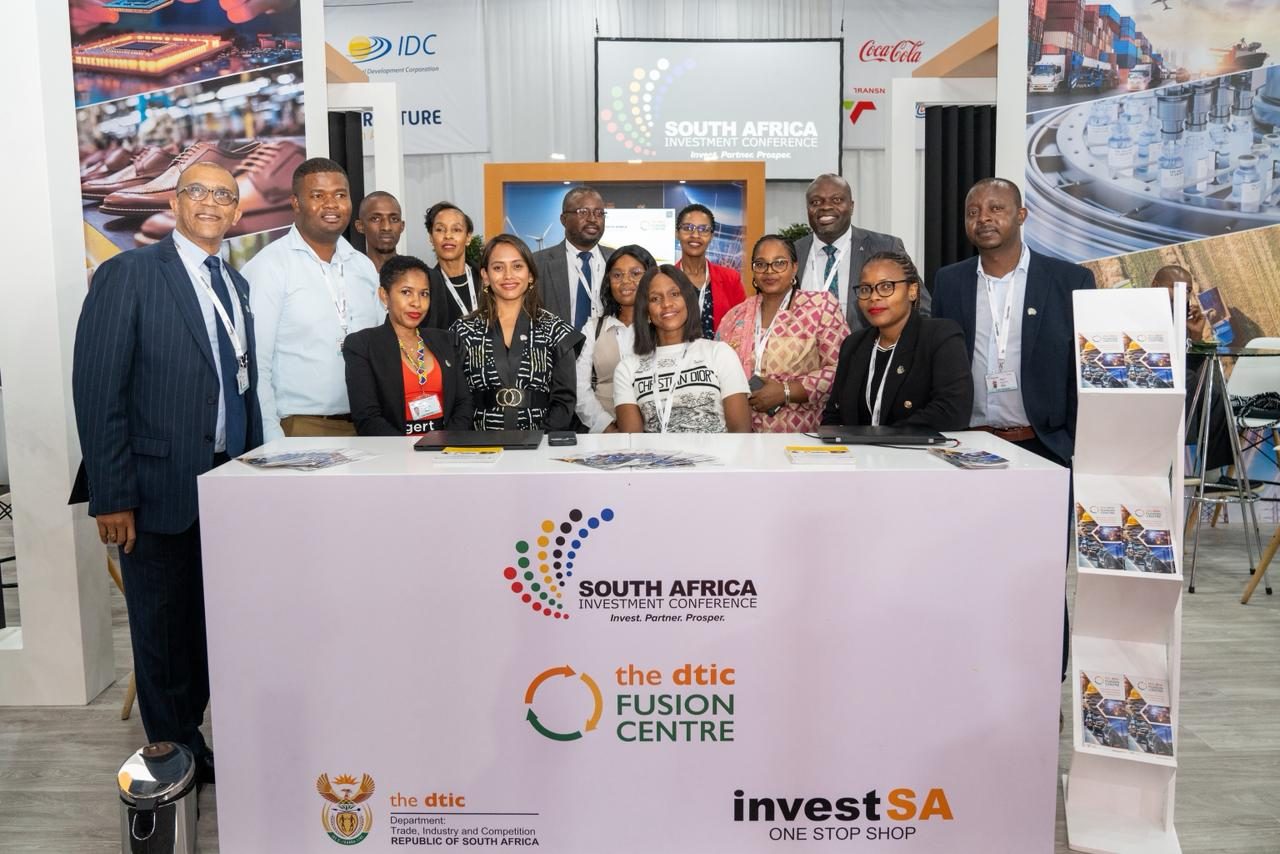
South African Department of Trade, Industry and Competition (the dtic), providing a One-Stop-Shop service to investors. It provides investment promotion, facilitation and aftercare, which is geared at fast-tracking projects and reducing government red-tape.
Map View
15 locations