
Public Services & Government
358 results
Sub-categories
Get quotes from multiple providers
Describe your job once and compare quotes from Public Services & Government providers — no payment now.

The mission of the Food and Beverage Manufacturing Industry Sector Education and Training Authority (FoodBev SETA) is to ensure that: relevant and quality learning standards and qualifications are available in this sector; a high quality of learning provision is maintained in this sector; and access to knowledge and skills is improved for all in the sector. FoodBev SETA's function is to promote, facilitate and incentivise skills development in the food and beverages manufacturing sector.

The vision of the African Renaissance and International Cooperation Fund (ARF) is a democratic, non-racial, non-sexist, conflict-free, developmental African continent. The ARF is committed to promoting South Africa's national interests and values, the African Renaissance and the creation of a better world for all. In order to ensure that funding through the ARF is effective, the ARF has adopted the values of the Paris and Rome declarations on aid effectiveness. The ARF will ensure that the following key values are adhered to: the recipient country must take ownership of the process of determining the immediate-, medium- and long-term actions that will address the issues contained in its project proposal; the recipient country must achieve an understanding of the political, economic and security considerations; and a needs assessment should be conducted with direct involvement and ownership of the process by the country concerned. Integrated planning and coordination are critical in ensuring that South Africa's efforts are in line with the development needs of the identified country. In addition to the above, the ARF will conduct its business while constantly adhering to the values of the Department of International Relations and Cooperation (DIRCO), namely: patriotism, loyalty, dedication, Ubuntu, constitutional values (Chapter 10) and Batho Pele. The aim of the African Renaissance and International Cooperation Fund is to: enhance cooperation between the Republic and other countries, in particular African countries, through the promotion of democracy, good governance, the prevention and resolution of conflict, socio-economic development and integration, humanitarian assistance and human resource development; to repeal three Acts; and to provide for matters incidental thereto.

The key role of the Gauteng Department of e-Government is the roll-out of a network infrastructure that will connect government facilities, including schools, hospitals, offices and economic zones. It endevours to: create an enabling platform and support service; enable GC...

Agrement South Africa (ASA) was established in terms of a delegation of Authority from the then Minister of Public Works in July 1969. The organisation is an entity of the National Department of Public Works and Infrastructure (NDPWI), and its mandate is within the built environment domain. As such, the legislation and mandates that impact the built environment and public works guide the functioning and operations of Agrement South Africa. The organisation is a schedule 3A public entity under the Public Finance Management Act and is established under the Agrement South Africa Act 11 of 2015. Agrement South Africa's vision is to be the leading regulator on non-standardised construction-related products and systems in South Africa. The organisation's mission is to enhance its position as an impartial and internationally acknowledged South African centre of excellence to: provide assurance to specifiers and users of the fitness-for-purpose of non-standardised construction -related products or systems; support and promote integrated socio-economic development in the Republic as it relates to the construction industry; support and promote the introduction and use of certified non-standardised construction related products or systems in the local or international market; and support policymakers to minimise the risk associated with using non-standardised construction related products or systems. The core mandate of ASA is the technical assessment and issuing of approval of certificates for non-standardised construction-related products and systems for which there are no South African National Standards. Assess and, if satisfied, certify the fitness-for-purpose of a non-standardised construction-related product or system; issue, amend, suspend, reinstate, withdraw or renew an ASA Certificate; enter into an agreement with a person, entity or organ of the State whose services are required to achieve an object or perform a function of ASA or the Board; provide services about the objects of ASA to a person, entity or organ of the State; exercise any other power as may be prescribed or necessary to achieve the objects of ASA; the recognised South African National Government Body that issues eco-labels for building materials and products; and the recognised South African National Government Body that issues Green Building Ratings for Government Buildings.

The objective of the Agricultural Produce Agents Council (APAC) is to regulate the occupations of fresh produce, export and livestock agents and to maintain and enhance the status and dignity of those occupations and the integrity of persons practicing those occupations. The Council's mission is to: fulfil its mandate under the Act; protect against dishonest practices; uphold its responsibility to maintain and enhance the occupations of fresh produce, export and livestock agents; and position the Council to effectively contribute in the development and transformation of the agricultural sector. APAC's vision is to be an innovative, supportive, proactive and responsive regulatory body.

The mission of the Agricultural Research Council (ARC) is to be a premier science institution that conducts research with partners, develops human capital and fosters innovation to support and develop the agricultural sector. The ARC's main functions are to: undertake and promote research, technology development and technology transfer; utilise the technological expertise in its possession and make it generally available; publish information concerning its objectives and functions, and establish facilities for the collection and dissemination of information in connection with research and development; publish the results of research; establish and control facilities in the fields of research, technology development and technology transfer that the Council may determine from time to time; cooperate with departments of state, institutions, persons and other authorities for the promotion and conduct of research, technology development and technology transfer; promote the training of research workers by means of bursaries or grants-in-aid for research, technology development and technology transfer, and contribute financially; offer research, development and technology transfer programmes; hire or let facilities; and cooperate with persons and authorities in other countries conducting or promoting research, technology development and technology transfer in agriculture.

The mission of Air Traffic and Navigation Services SOC Ltd (ATNS) is to provide safe, expeditious and efficient air traffic management solutions and associated services while ensuring long-term economic, social and environmental sustainability. ATNS is responsible for air traffic control in approximately 6% of the world's airspace. Their services extend further than the familiar air traffic control service, into the provision of vitally important aeronautical information used for all flight planning purposes, as well as search and rescue coordination activities and the maintenance of a reliable navigation infrastructure. Their operations also include the supply of aeronautical information services, technical maintenance and aerodrome services; alert, search and rescue coordination services; management of the flexible use of airspace through the Central Airspace Unit (CAMU); support for special events, and special requirements such as test flights and demonstration flights; the implementation and maintenance of a terrestrial-based navigational structure; and the training of licensed air traffic controllers and technical staff through the Aviation Training Academy (ATA).

The mission of Airports Company South Africa SOC Ltd (ACSA) is to develop and manage world-class airports for the benefit of all stakeholders. The Company's strategy is built on collaborative and coherent engagements with its stakeholders. The Company focuses on strengthening its internal business processes and making the most of its bespoke information technology. ACSA directs its efforts towards improving its employees' skills and understanding as part of its effort to build human capital.
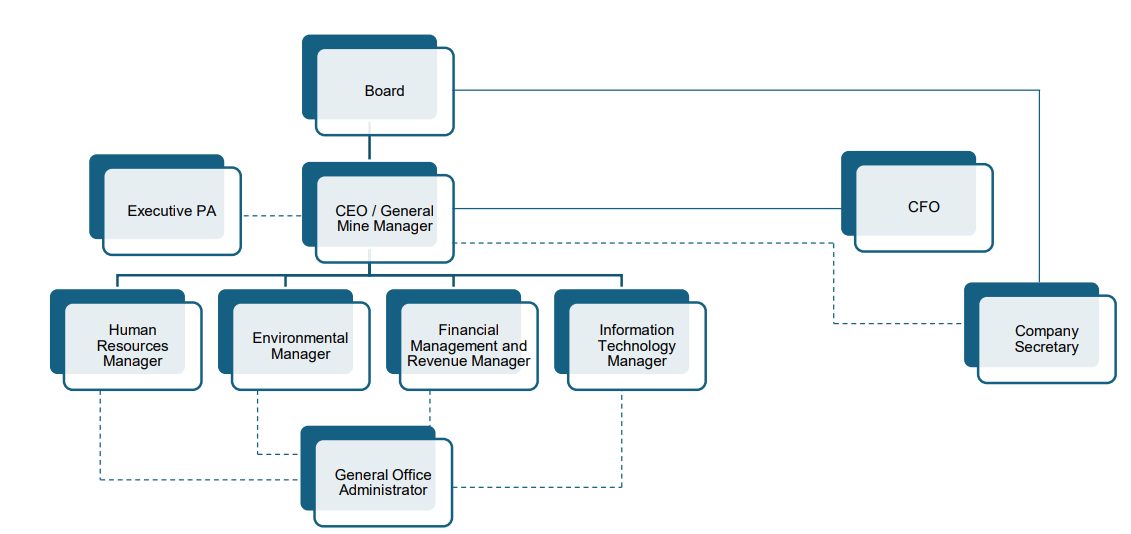
The mission of Alexkor SOC Ltd is to operate a growing, profitable and sustainable mining organisation that contributes to the developmental needs of the communities. Alexkor's objectives are: turning Alexkor around into a viable dynamic mining company; focusing on organic growth at Alexander Bay; acquisition of new opportunities; creating a sustainable, healthy, safe and environmentally responsible organisation; caring for people, providing sound leadership and building credible processes; and building strong relationships with all strategic partners.
Its mission is to provide strategic direction and high-quality services while safeguarding the environment, cultural heritage, and communities for sustainable development. Its goals are to deliver quality infrastructure and innovative asset management for long-term economic growth.

The Public Service Sector Education and Training Authority (PSETA) is a statutory body entrusted with driving skills development across the public sector. As mandated by the Skills Development Act and aligned with the National Skills Development Plan (NSDP) 2030, PSETA plays a critical role in shaping a professional, ethical and capable public service workforce. As the designated sector education and training authority, PSETA leads transversal functions across national and provincial departments, legislatures, public entities and government-exclusive institutions. It ensures that skills planning, programme development and quality assurance are strategically aligned with the state's evolving needs. Through its value chain – spanning research and skills planning, programme design, quality assurance, stakeholder partnerships, and performance monitoring – PSETA ensures the public sector is equipped with the right skills to deliver on government priorities. It develops qualifications, accredits providers, certifies learners, and supports critical programmes like learnerships, internships and artisan development. As a trusted authority, PSETA is committed to driving impactful, inclusive and sustainable skills development that strengthens institutional capacity and supports service delivery excellence across the public sector.

The mission of the Eastern Cape Department of Community Safety is to build safer communities through civilian oversight of the police and community participation. The Department's strategic goals are to ensure efficient and effective governance and administration of the Department; exercise oversight over the South African Police Service (SAPS) and Metro Police Services in the Eastern Cape; and build safer communities through effective partnerships. The Department's legal mandate is to: monitor and evaluate the implementation of policing policy in the province; evaluate and monitor police conduct in the province; develop and evaluate safety models and monitoring tools; assist the Civilian Secretariat with any monitoring and evaluation projects; promote community police relations and establish and promote partnerships; and manage the enhancement of community safety structures within the province. Furthermore, the Department must: monitor the implementation by SAPS of the recommendations made by IPID; provide the Minister with regular reports on SAPS compliance; report on the implementation of the Domestic Violence Act of 1998, dealing with SAPS applications for exemptions, etc.; strengthen communities against crime; prevent violence; prevent corruption; and strengthen the criminal justice system.

The mission of the Eastern Cape Department of Cooperative Governance and Traditional Affairs is to promote a developmental local state and traditional institutions that are accountable, focused on citizen's priorities, capable of delivering high quality services consistently and sustainably through cooperative governance and participatory democracy. The Department's strategic goals are: to be an enabling environment to enhance service delivery through integrated support services; to strengthen municipal institutional capacity to promote governance and effective service delivery; effective and efficient planning and development in municipalities; liveable integrated cities, towns and rural areas that provide basic income security; to have enabling viable sustainable developmental municipalities that deliver basic services; and an enabling service environment in traditional leadership institutions to improve socio-economic development through integrated support services.

The mission of Blind SA is to promote the interests of all blind people by: combating poverty; empowering blind people by, amongst others, the provision of Braille, the distribution of information, and the provision of other developmental services (members of member organisations of Blind SA enjoy preference); and acting as a pressure group with regard to any matter concerning blind people. Blind SA's objectives are to: focus on a specific topic and target a particular sector, over and above general awareness raising, by using its own publications, the public media, serving and networking with other organisations, participating in public forums, and making representations to government, including submissions on legislation; assist workers to sustain their jobs and to gain promotion through appropriate training and acquisition of work-related equipment and information; help blind students to obtain special equipment, study material, transport and reader services, and bursaries; make interest-free loans available from its revolving fund for the purchase of word- and study-related equipment and for household goods; produce Braille to order for schools, university students and individual adults in all the official languages of South Africa, and produce other important products, including magazines, calendars, postal code books, timetables, broadcasting and motor rally schedules, agendas, minutes, and reports; offer a Braille tutoring service; provide orientation and mobility training; provide appropriate, reliable information about the world around us by using Braille, ink print, audio tape, the Internet, the telephone and computer discs; provide Blind SA publications; provide various forms of social and cultural activity and upliftment; look after the interests of retired workers and of the large number of South Africans who lose their sight in later life; cater for the needs of elderly persons; and address all issues regarding the education of blind and partially sighted learners.

The vision of the Eastern Cape Department of Economic Development, Environmental Affairs and Tourism is of a province where economic growth and sound environmental management underpin sustainable development. Its main strategic goal is innovation for sustainable development, with the strategic objectives being to improve organisational performance, local economic participation, emission reduction, carbon reduction and green economy initiatives, and to secure the provincial conservation status. The primary mandate change resulted from the formalisation of the 12 key outcomes identified and agreed to by the National Cabinet. The Department had to adjust its strategic plan to demonstrate the following outcomes: decent employment through inclusive economic growth; an efficient, competitive and responsive economic infrastructure network; environmental assets and natural resources that are well protected and continually enhanced; an efficient, effective and development-orientated public service; and an empowered, fair and inclusive citizenship.
No map locations
These listings don't have coordinates yet.